
A Simple Guide to OpenFn and X-Road for Data Exchange DPI
OpenFn and X-Road are both essential tools in the data exchange ecosystem, but they serve different purposes. This guide explains how workflow automation and information mediators work together - or independently - to enable secure, efficient data sharing across government systems.
At OpenFn, we're often asked how different tools across the data exchange ecosystem can and should be used together. To create and maintain high-quality public service integrations that cut across systems, we need to consider how and when to use tools like OpenFn with other parts of the data exchange layer, like X-Road. To illustrate this, we have created a non-technical document to consider the different roles that each tool might play.
The Big Picture
Across mature digital ecosystems, data needs to move between different owners. Tax authorities need data from business and land registries. Social protection programs need to share data with civil registration departments. Frontline workers need the latest information from supply chain systems and central data hubs. All this information needs to move securely and efficiently between different digital systems.
OpenFn and X-Road can be used together or independently to create a harmonious digital state, and are specialized to fulfill different functionalities.
Meet the Tools
To help us conceptualize, imagine a busy city where goods and information need to move between different buildings and organizations. What roles might OpenFn and X-Road play?
OpenFn: The intelligent courier service
(a "workflow engine" in the GovStack Building Block specifications)
Think of OpenFn as an intelligent courier service in our city. As well as moving packages (data) from one building to another, it can also translate documents into different languages (transform data formats), sort and organize packages before delivery (clean and structure data), and follow complex multi-step delivery instructions ("if this social security application is approved, send alerts to these three systems and then update those two registries").
The courier service can perform deliveries in real-time when triggered by an event (e.g. "do X every time a form is submitted") or work on a regular schedule (e.g. "do X every Thursday at 8am"). It keeps detailed records of every delivery (full audit trail). It can automatically re-deliver packages when people are not at home (re-run data workflows) and alert anyone interested about road works or issues that stop packages from being delivered at all (error handling).
Note that the whole city may use a single courier service, or different districts might run their own. One might be operated by the Ministry of Finance, another by a specific district office, and another by an entirely different ministry. They all work independently but can coordinate when needed as they use the same routing mechanisms and operational standards.
OpenFn in action:
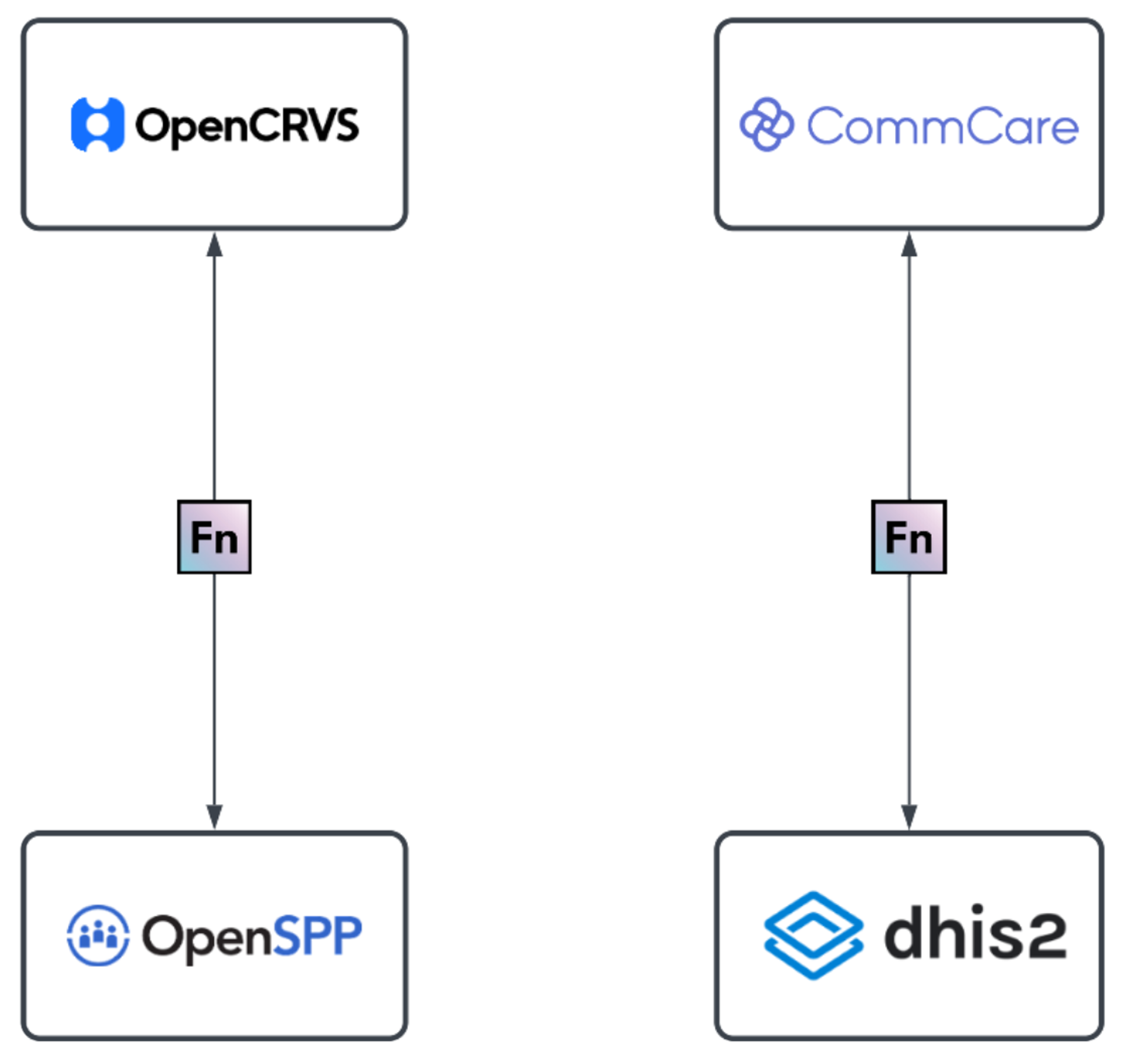
At early stages of maturity, our city might use OpenFn for moving data between buildings as shown above, without any additional security or governance layers. The courier service handles direct deliveries between specific locations.
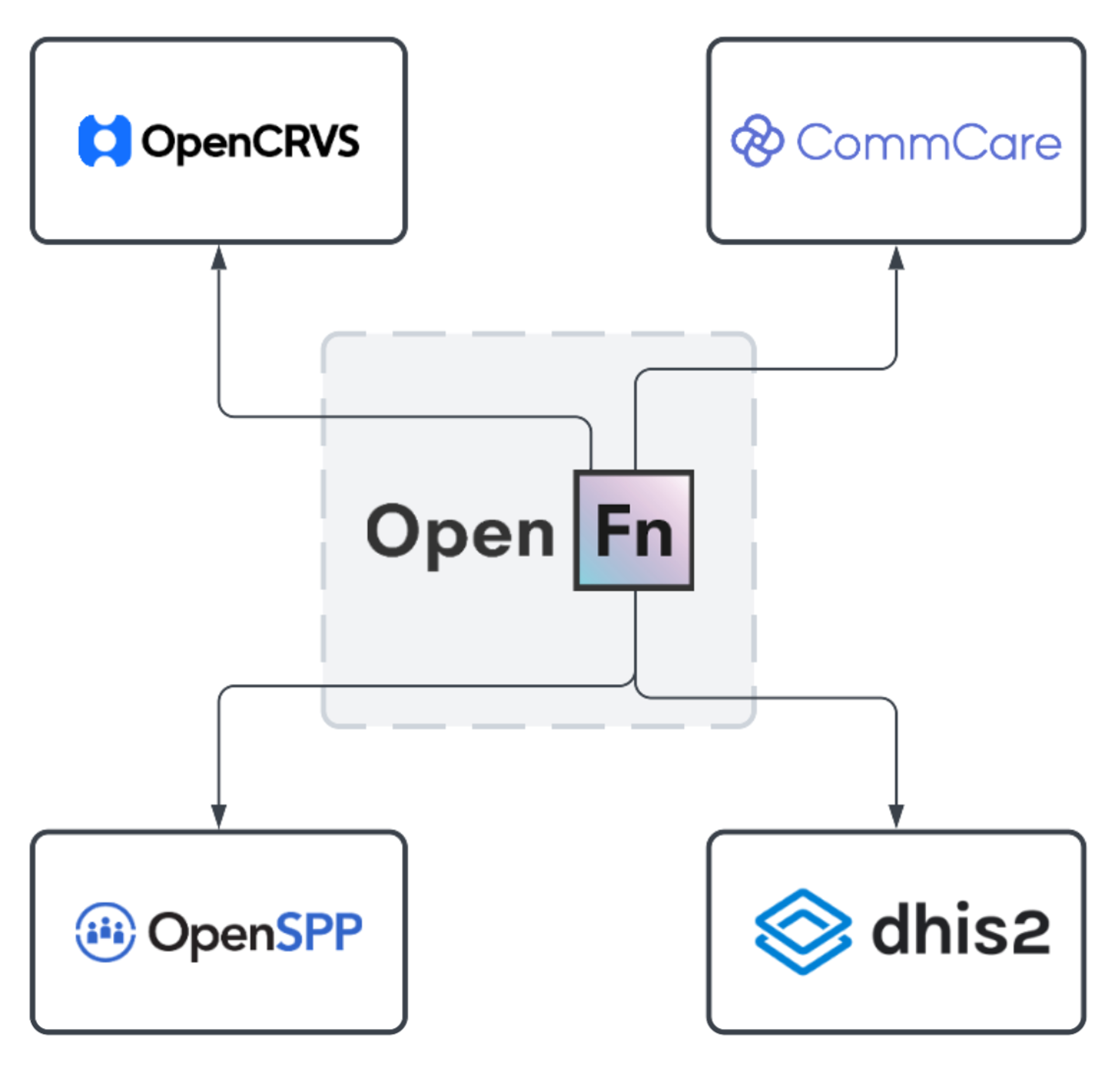
As the city grows, OpenFn often becomes a central sorting facility where packages from multiple buildings are processed, organized, and dispatched to their final destinations.
X-Road: The secure public transportation network
(a decentralized "information mediator" in the GovStack Building Block specifications)
X-Road is like a network of well policed roads, all with security checkpoints stationed along them. When configured, it double verifies all travelers (and courier services, like OpenFn!) but it doesn't force them through one central station (decentralized security protocols), allowing direct transit between different districts (decentralized architecture, no single point of failure).
Each major “delivery point” in the city has its own security checkpoint that follows the same security protocols (distributed security). This allows different districts to communicate under the same security standards while maintaining their own lists of “who can access what” (distributed ownership via a federated architecture). All traffic through these checkpoints is logged completely (full audit trail).
Note that if a city implements X-Road, people still may use private roads within a specific district (all traffic within one ministry might run on internal networks), but for traffic across district boundaries, there will usually only be one X-Road implementation and agreed protocols for using the public roads. Think of it like the difference between an “interstate highway system” and the local county roads.
X-Road facilitating inter-district data exchange:
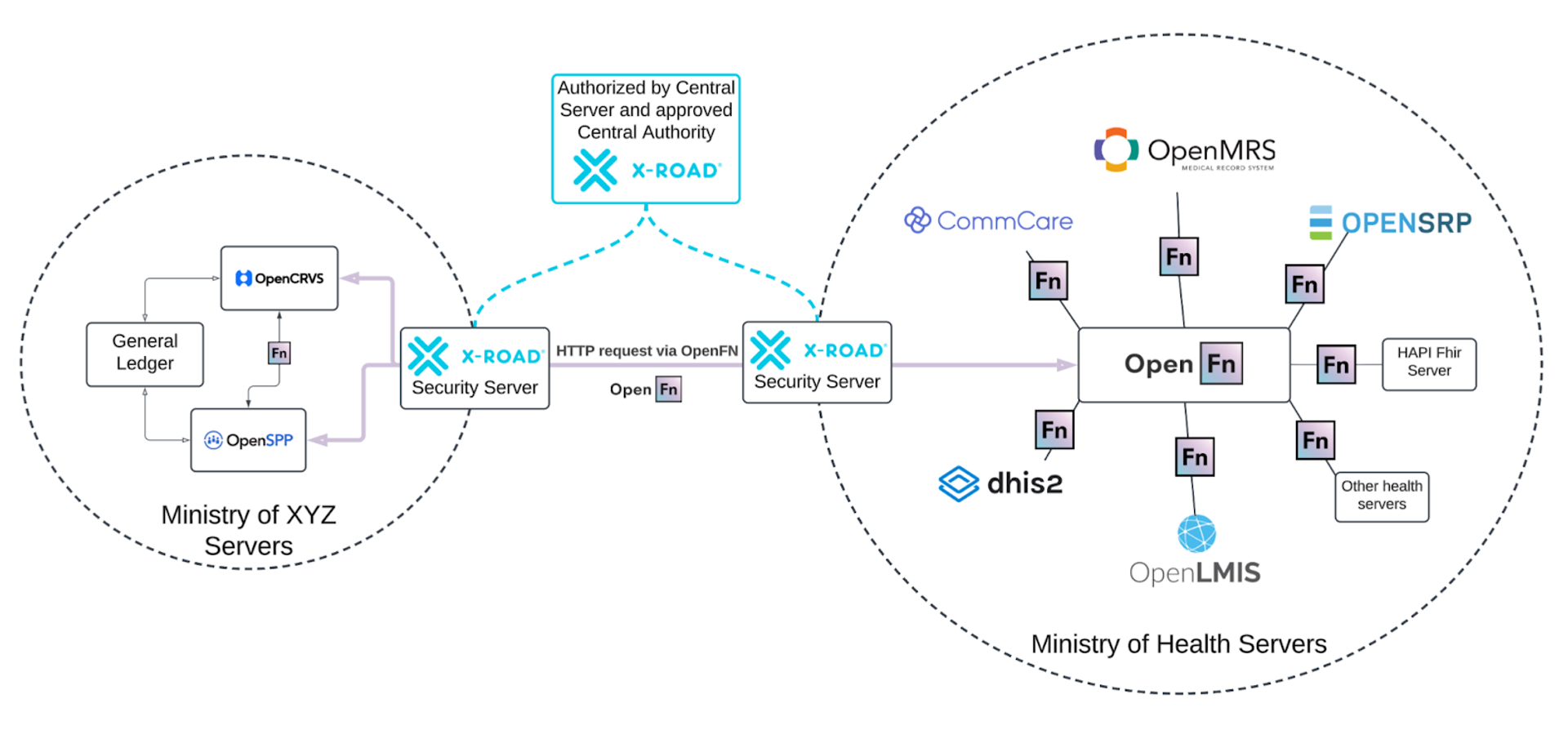
The image above shows X-Road infrastructure connecting two government ministries through secure, centrally authorized data exchange protocols.
In this diagram, you can see how two different districts (Ministry of XYZ and Ministry of Health) each operate their own security checkpoints. A Central Authority (like a city traffic department) authorizes these checkpoints and ensures they all follow the same rules, but doesn't control what happens inside each district's buildings.
Key Differences
Control style
OpenFn: Like the courier service itself that sorts, processes, and delivers packages. It complies with whichever security system is in place (private district roads or public X-Road infrastructure) and provides tracking so you can see where packages are in the delivery process and when they fail to arrive, so that you can re-run them as needed.
X-Road: Like the well-policed public roads, where every major building has its own secure entrance. Travelers can move directly between buildings using the public roads, but must pass through security checkpoints at each location.
Who's in charge
OpenFn: Focuses on the actual work of processing and delivering packages. It works with any security approach, and enforces its own security best-practices when acting alone. Multiple courier services might operate in the same city, each owned by different districts and complying with different security protocols, but all complying with the stated security protocols of the ecosystem. Sometimes, those protocols may be defined by X-Road.
X-Road: Each district runs their own security checkpoint based on shared protocols. A Central Authority (like a transportation department) ensures all checkpoints follow the same rules and certifies that each one is legitimate. That Central Authority is often hosted by a neutral government body, but each district controls its own checkpoint.
Where they're used
OpenFn: Can operate in any district to support any deliveries. Common across social services, civil registration, financial systems, agriculture offices, education departments, and general government service delivery. Adoption can start small (with one pilot workflow automating data sharing), and grow as maturity increases.
X-Road: Designed specifically for city-wide and inter-city implementation. It provides additional security and trust infrastructure for cross-district work, especially when different agencies or ministries need to exchange data but maintain their own control and sovereignty.
When to Use What
Stages of maturity
The tools you choose depend on how developed your city's infrastructure is. OpenFn can start working immediately to connect any buildings via a single delivery route. It is cheap to get going and it could serve as your entire courier system. X-Road becomes relevant when you need secure cross-district exchange with each different district (or Ministry) maintaining its own security control. Different cities are 'ready' for different tools, depending on their infrastructure maturity and governance needs.
Use OpenFn when:
You want to make it easier to build and maintain integrations between systems. Like an intelligent courier service, it can pick up data from one building and deliver it to another, translate between different document formats, follow complex delivery rules with multiple steps, work on a regular schedule or respond to real-time notifications, and comply with whatever security requirements are in place.
Example: Automatically processing beneficiary applications that arrive at the social services office, checking them against civil registry records and tax databases, applying eligibility rules, triggering payment instructions to the treasury, and updating case management files, all without manual intervention.
Use X-Road when:
You need a secure public transportation network (but can “bring your own” courier service) where different districts maintain independence, each building controls its own security and access policies, direct communication between districts is required without going through a central hub, and scale and federation are priorities because you're connecting multiple agencies or even multiple cities.
Example: Validating that data shared between a national tax authority, business registry, social insurance agency, and customs office are being securely exchanged. Each agency maintains full control over who can access their systems and what data they expose, but all follow the same security protocols for inter-agency communication.
Use them together when:
You combine both tools to create comprehensive infrastructure. X-Road provides well-policed public roads between districts, while OpenFn operates the courier services that actually move and process packages, adhering to X-Road's infrastructure when packages need to cross district boundaries.
A Note on Feature Differences and Overlap
While these tools work well together, there is some feature overlap worth understanding.
Generating audit logs: Both X-Road and OpenFn maintain complete records of all activities. X-Road logs who traveled on which roads, when they passed through checkpoints, and which security checks they completed. OpenFn logs what happened to each package: what sorting and repackaging occurred, what delivery rules were applied, and which buildings received deliveries. Together, these complementary logs provide complete accountability for the activities that happen across an ecosystem.
Choosing which Tools to Implement
Start with what you need most. A city can function with just courier services initially. If it’s helpful, you can think of OpenFn as a drone-based courier service. It can deliver data to where it needs to go even if there are no roads at all.
Then, add X-Road Security as cross-district data sharing starts to require additional trust infrastructure and federated security protocols.
Getting Started
For OpenFn: Sign up for free at app.openfn.org to start building workflows, or book a demo to discuss your specific integration requirements.
For X-Road: The Nordic Institute for Interoperability Solutions provides resources and support for X-Road adoption.
For combined implementation: to discuss your specific architecture. The OpenFn team has experience implementing workflow automation in X-Road environments and can help design an integration strategy that works for your city.
Disclosure: We use AI to improve research, organization, and content development in our writing.

Written by
Jack Hilton